Showing posts with label devops. Show all posts

Thursday, June 16, 2016

Dev-Sec.io Automated Hardening Framework

Automated configuration management tools like Ansible, Chef and Puppet are changing the way that organizations provision and manage their IT infrastructure. These tools allow engineers to programmatically define how systems are set up, and automatically install and configure software packages. System provisioning and configuration becomes testable, auditable, efficient, scalable and consistent, from tens to hundreds or thousands of hosts.

These tools also change the way that system hardening is done. Instead of following a checklist or a guidebook like one of the CIS Benchmarks, and manually applying or scripting changes, you can automatically enforce hardening policies or audit system configurations against recognized best practices, using pre-defined hardening rules programmed into code.

An excellent resource for automated hardening is a set of open source templates originally developed at Deutsche Telekom, under the project name "Hardening.io". The authors have recently had to rename this hardening framework to Dev-Sec.io

It includes Chef recipes and Puppet manifests for hardening base Linux, as well as for SSH, MySQL and PostgreSQL, Apache and Nginx. Ansible support at this time is limited to playbooks for base Linux and SSH. Dev-Sec.io works on Ubuntu, Debian, RHEL, CenOS and Oracle Linux distros.

For container security, the project team have just added an InSpec profile for Chef Compliance against the CIS Docker 1.11.0 benchmark.

Dev-Sec.io is comprehensive and at the same time accessible. And it’s open, actively maintained, and free. You can review the rules, adopt them wholesale, or cherry pick or customize them if needed. It’s definitely worth your time to check it out on GitHub: https://github.com/dev-sec

Thursday, June 2, 2016

DevOpsSec: Using DevOps to Secure DevOps

I finished writing an e-book for O'Reilly on DevOpsSec: Securing Software through Continuous Delivery. It explains how to wire security into Continuous Delivery, and how to use Continuous Delivery and programmable Infrastructure as Code and other DevOps practices to build and operate more secure systems. It is based on approaches followed by organizations like Etsy, Netflix, LMAX, Amazon, Intuit, Google, and others, including my own firm.

The e-book is available for free download at: http://www.oreilly.com/webops-perf/free/devopssec.csp. I'd appreciate feedback and corrections.

Monday, April 18, 2016

DevOpsDays: Empathy, Scaling, Docker, Dependencies and Secrets

Last week I attended DevOpsDays 2016 in Vancouver. I was impressed to see how strong the DevOps community has grown from the time that I attended my first DevOpsDays event in Mountain View in 2012. There were more than 350 attendees, all of them doing interesting and important work.

Here are the main themes that I followed at this conference:

Empathy – Humanizing Engineering and Ops

There was a strong thread running through the conference on the importance of the human side of engineering and operations, understanding and empathizing with people across the organization. There were two presentations specifically on empathy: one from an engineering perspective by Joyent’s Matthew Smillie, and another excellent presentation on the neuroscience of empathy by Dave Mangot at Librato, which explained how we are all built for empathy and that it is core to our survival. There was also a presentation on gender issues, and several breakout sessions on dealing with people issues and bringing new people into DevOps.

Another side to this was how we use tools to collaborate and build connections between people. More people are depending more on – and doing more with – chat systems like HipChat and Slack to do ChatOps. Using chat as a general interface to other tools, leveraging bots like Hubot to automatically trigger and guide actions, such as tracking releases and handling incidents.

In some organizations, standups are being replaced with Chatups, as people continue to find new ways to engage and connect with other people working remotely and inside and outside of teams.

Scaling DevOps

All kinds of organizations are dealing with scaling problems in DevOps.

Scaling their organizations. Dealing with DevOps at the extremes, at really large organizations and figuring out how to effectively do DevOps in small teams.

Scaling Continuous Delivery. Everyone is trying to push out more changes, faster and more often in order to reduce risk (by reducing the batch size of changes), increase engagement (for users and developers), and improve the quality of feedback. Some organizations are already reaching the point where they need to manage hundreds or thousands of pipelines, or optimize single pipelines shared by hundreds of engineers, building and shipping out changes (or newly baked containers) several times a day to many different environments.

A common story for CD as organizations scale up goes something like this:

  1. Start out building a CD capability in an ad hoc way, using Jenkins and adding some plugins and writing custom scripts. Keep going until it can’t keep up.
  2. Then buy and install a commercial enterprise CD toolset, transition over and run until it can’t keep up.
  3. Finally, build your own custom CD server and move your build and test fleet to the cloud and keep going until your finance department shouts at you.
Scaling testing. Coming up with effective strategies for test automation where it adds most value – in unit testing (at the bottom of the test pyramid), and end-to-end system testing (at the top of the pyramid). Deciding where to invest your time. Understanding the tools and how to use them. What kind of tests are worth writing, and worth maintaining.

Scaling architecture. Which means more and more experiments with microservices.

Docker, Docker, Docker

Docker is everywhere. In pilots. In development environments. In test environments especially. And more often now, in production. Working with Docker, problems with Docker, and questions about Docker came up in many presentations, break outs and hallway discussions.

Docker is creating new problems at the start and end of the CD pipeline.

First, it moves configuration management upfront into the build step. Every change to the application or change to the stack that it is built and runs on requires you to “bake a new cake” (Diogenes Rettori at Openshift) and build up and ship out a new container. This places heavy demands on your build environment. You need to find effective and efficient ways to manage all of the layers in your containers, caching dependencies and images to make builds run fast.

Docker is also presenting new challenges at the production end. How do you track and manage and monitor clusters of containers as the application scales out? Kubernetes seems to be the tool of choice here.

Depending on Dependencies

More attention is turning to builds and dependency management, managing third party and open source dependencies. Identifying, streamlining and securing these dependencies.

Not just your applications and their direct dependencies – but all of the nested dependencies in all of the layers below (the software that your software depends on, and the software that this software depends on, and so on and so on). Especially for teams working with heavy stacks like Java.

There was a lot of discussion on the importance of tracking dependencies and managing your own dependency repositories, using tools like Archiva, Artifactory or Nexus, and private Docker registries. And stripping back unnecessary dependencies to reduce the attack surface and run-time footprint of VMs and containers. One organization does this by continuously cutting down build dependencies and spinning up test environments in Vagrant until things break.

Docker introduces some new challenges, by making dependency management seem simpler and more convenient, and giving developers more control over application dependencies – which is good for them, but not always good for security:

  • Containers are too fat by default - they include generic platform dependencies that you don’t need and - if you leave this up to developers - developer tools that you don’t want to have in production.
  • Containers are shipped with all of the dependencies baked in. Which means that as containers are put together and shipped around, you need to keep track of what versions of what images were built with what versions of what dependencies and when, where they have been shipped to, and what vulnerabilities need to be fixed.
  • Docker makes it easy to pull down pre-built images from public registries. Which means it is also easy to pull images that are out of date or that could contain malware.
You need to find a way to manage these risks without getting in the way and slowing down delivery. Container security tools like Twistlock can scan for vulnerabilities, provide visibility into run-time security risks, and enforce policies.

Keeping Secrets Secret

Docker, CD tooling, automated configuration management tools like Chef and Puppet and Ansible and other automated tooling create another set of challenges for ops and security: how to keep the credentials, keys and other secrets that these tools need safe. Keeping them out of code and scripts, out of configuration files, and out of environment variables.

This needs to be handled through code reviews, access control, encryption, auditing, frequent key rotation, and by using a secrets manager like Hashicorp’s Vault.

Passion, Patterns and Problems

I met a lot of interesting, smart people at this conference. I experienced a lot of sincere commitment and passion, excitement and energy. I learned about some cool ideas, new tools to use and patterns to follow (or to avoid).

And new problems that need to be solved.

Wednesday, November 11, 2015

DevOps for Financial Services

The e-book I wrote this summer for O'Reilly DevOps for Finance: Reducing Risk through Continuous Delivery. It looks at DevOps and Continuous Delivery from the perspective of improving reliability and reducing operational and technical risk, while improving security and meeting compliance requirements. It includes an analysis of the challenges that financial services organizations face, and how to address these challenges, with case studies from LMAX, ING, Capital One, Wealthfront and my own firm.

Monday, June 22, 2015

What does DevOps mean to Developers?

A post that I wrote for JavaWorld DevOps for Developers: A New Agility, describes how DevOps changes the way that developers work, and what they need to know to succeed.

Wednesday, June 17, 2015

Does DevOps Reduce Technical Debt – or Make it Worse?

DevOps can help reduce technical debt in some fundamental ways.

Continuous Delivery/Deployment

First, building a Continuous Delivery/Deployment pipeline, automating the work of migration and deployment, will force you to clean up inconsistencies and holes in configuration and code deployment, and inconsistencies between development, test and production environments.

And automated Continuous Delivery and Infrastructure as Code gets rid of dangerous one-of-a-kind snowflakes and configuration drift caused by making configuration changes and applying patches manually over time. Which makes systems easier to setup and manage, and reduces the risk of an un-patched system becoming the target of a security attack or the cause of an operational problem.

A CD pipeline also makes it easier, cheaper and faster to pay down other kinds of technical debt. With Continuous Delivery/Deployment, you can test and push out patches and refactoring changes and platform upgrades faster and with more confidence.

Positive Feedback

The Lean feedback cycle and Just-in-Time prioritization in DevOps ensures that you’re working on whatever is most important to the business. This means that bugs and usability issues and security vulnerabilities don’t have to wait until after the next feature release to get fixed. Instead, problems that impact operations or the users will get fixed immediately.

Teams that do Blameless Post-Mortems and Root Cause(s) Analysis when problems come up will go even further, and fix problems at the source and improve in fundamental and important ways.

But there’s a negative side to DevOps that can add to technical debt costs.

Erosive Change

Michael Feathers’ research has shown that constant, iterative change is erosive: the same code gets changed over and over, the same classes and methods become bloated (because it is naturally easier to add code to an existing method or a method to an existing class), structure breaks down and the design is eventually lost.

DevOps can make this even worse.

DevOps and Continuous Delivery/Deployment involves pushing out lots of small changes, running experiments and iteratively tuning features and the user experience based on continuous feedback from production use.

Many DevOps teams work directly on the code mainline, “branching in code” to “dark launch” code changes, while code is still being developed, using conditional logic and flags to skip over sections of code at run-time. This can make the code hard to understand, and potentially dangerous: if a feature toggle is turned on before the code is ready, bad things can happen.

Feature flags are also used to run A/B experiments and control risk on release, by rolling out a change incrementally to a few users to start. But the longer that feature flags are left in the code, the harder it is to understand and change.

There is a lot of housekeeping that needs to be done in DevOps: upgrading the CD pipeline and making sure that all of the tests are working; maintaining Puppet or Chef (or whatever configuration management tool you are using) recipes; disciplined, day-to-day refactoring; keeping track of features and options and cleaning them up when they are no longer needed, getting rid of dead code and trying to keep the code as simple as possible.

Microservices and Technology Choices

Microservices are a popular architectural approach for DevOps teams.

This is because loosely-coupled Microservices are easier for individual teams to independently deploy, change, refactor or even replace.

And a Microservices-based approach provides developers with more freedom when deciding on language or technology stack: teams don’t necessarily have to work the same way, they can choose the right tool for the job, as long as they support an API contract for the rest of the system.

In the short term there are obvious advantages to giving teams more freedom in making technology choices. They can deliver code faster, quickly try out prototypes, and teams get a chance to experiment and learn about different technologies and languages.

But Microservices “are not a free lunch”. As you add more services, system testing costs and complexity increase. Debugging and problem solving gets harder. And as more teams choose different languages and frameworks, it’s harder to track vulnerabilities, harder to operate, and harder for people to switch between teams. Code gets duplicated because teams want to minimize coupling and it is difficult or impossible to share libraries in a polyglot environment. Data is often duplicated between services for the same reason, and data inconsistencies creep in over time.

Negative Feedback

There is a potentially negative side to the Lean delivery feedback cycle too.

Constantly responding to production feedback, always working on what’s most immediately important to the organization, doesn’t leave much space or time to consider bigger, longer-term technical issues, and to work on paying off deeper architectural and technical design debt that result from poor early decisions or incorrect assumptions.

Smaller, more immediate problems get fixed fast in DevOps. Bugs that matter to operations and the users can get fixed right away instead of waiting until all the features are done, and patches and upgrades to the run-time can be pushed out more often. Which means that you can pay off a lot of debt before costs start to compound.

But behind-the-scenes, strategic debt will continue to add up. Nothing’s broke, so you don’t have to fix anything right away. And you can’t refactor your way out of it either, at least not easily. So you end up living with a poor design or an aging technology platform, slowly slowing down your ability to respond to changes, to come up with new solutions. Or forcing you to continue filling in security holes as they come up, or scrambling to scale as load increases.

DevOps can reduce technical debt. But only if you work in a highly disciplined way. And only if you raise your head up from tactical optimization to deal with bigger, more strategic issues before they become real problems.

Friday, June 5, 2015

Software Architecture in DevOps

A new book by Len Bass, Ingo Weber and Liming Zhu “DevOps: A Software Architect’s Perspective”, part of the SEI Series in Software Engineering, looks at how DevOps affects architectural decisions, and a software architect’s role in DevOps.

The authors focus on the goals of DevOps: to get working software into production as quickly as possible while minimizing risk, balancing time-to-market against quality.

“DevOps is a set of practices intended to reduce the time between committing a change to a system and the change being placed into normal production, while insuring high quality”
These fundamental practices are:
  1. Engaging operations as a customer and partner, “a first-class stakeholder”, in development. Understanding and satisfying requirements for deployment, logging, monitoring and security in development of an application.
  2. Engaging developers in incident handling. Developers taking responsibility for their code, making sure that it is working correctly, helping (often taking the role of first responders) to investigate and resolve production problems.
    This includes the role of a “reliability engineer” on every development team, someone who is responsible for coordinating downstream changes with operations and for ensuring that changes are deployed successfully.
  3. Ensuring that all changes to code and configuration are done using automated, traceable and repeatable mechanisms – a deployment pipeline.
  4. Continuous Deployment of changes from check-in to production, to maximize the velocity of delivery, using these pipelines.
  5. Infrastructure as Code. Operations provisioning and configuration through software, following the same kinds of quality control practices (versioning, reviews, testing) as application software.

Culture and collaboration between developers and operations, shared values and organizational issues, the softer people-side of DevOps, are considered only insofar as they are factors that could affect time-to-market delivery velocity or quality.

Cloud Architecture and Microservices

As a reference for architects, the book focuses on architectural considerations for DevOps. It walks through how Cloud-based systems work, virtualization concepts and especially microservices.

While DevOps does not necessarily require making major architectural changes, the authors argue that most organizations adopting DevOps will find that a microservices-based approach, as pioneered at organizations like Netflix and Amazon, by minimizing dependencies between different parts of the system and between different teams, will also minimize the time required to get changes into production – the first goal of DevOps.

Conway’s Law also comes into play here. DevOps work is usually done by small agile cross-functional teams solving end-to-end problems independently, which means that they will naturally end up building small, independent services:

“Having an architecture composed of small services is a response to having small teams.”

But there are downsides and costs to a microservice-based approach.

As Martin Fowler and James Lewis point out, microservices introduce many more points of failure. Which means that resilience has to be designed and built into each service. Services cannot trust their clients or the other services that they call out to. You need to add defensive checking on data and anticipate failures of other services, implement time-outs and retries, and fall back alternatives or safe default behaviors if another service is unavailable. You also need to design your service to minimize the impact of failure on other services, and to make it easier and faster to recover/restart.

Microservices also increase the cost and complexity of end-to-end system testing. Run-time performance and latency degrade due to the overhead of remote calls. And monitoring and troubleshooting in production can be much more complicated, since a single action often involves many microservices working together (an example at LinkedIn, where a single user request may chain to as many as 70 services).

DevOps in Architecture: Monitoring

In DevOps, monitoring becomes a much more important factor in architecture and design, in order to meet operations requirements.

The chapter on monitoring explains what you need to monitor and why, DevOps metrics, challenges in monitoring systems under continuous change, monitoring microservices and monitoring in the Cloud, and common log management and monitoring tools for online systems.

Monitoring also becomes an important part of live testing in DevOps (Monitoring as Testing), and plays a key role in Continuous Deployment. The authors look at common kinds of live testing, including canaries, A/B testing, and Netflix’s famous Simian Army in terms of passive checking (Security Monkey, Compliance Monkey) and active live testing (Chaos Monkey and Latency Monkey).

DevOps in Architecture: Security

Security is another important cross-cutting concern in software architecture addressed in this book. It looks at security fundamentals including how to identify threats (using Microsoft’s STRIDE model) and the resources that need to be protected, CIA, identity management, access controls. It provides an overview of the security controls in NIST 800-53, and common security issues with VMs and in Cloud architectures (specifically AWS).

In DevOps, security needs to be wired into Continuous Deployment:

  1. Enforcing that all changes to code and configuration are done through the Continuous Deployment pipeline
  2. Security testing should be included in different stages of the Continuous Deployment pipeline
  3. Securing the pipeline itself, including the logs and the artifacts
and security checks need to be part of monitoring (such as Netflix’s Compliance Monkey and Security Monkey).

Continuous Deployment Pipeline and Gatekeepers

Developers – and architects – have to take responsibility for building their automated testing and deployment pipelines. The book explains how Continuous Deployment leverages Continuous Integration, and common approaches to code management and test automation. And it emphasizes the role of gatekeepers along the pipeline – manual decisions or automated checks at different points to determine if it is ok to go forward, from development to testing to staging to live production testing and then to production.

DevOps and Modern Software Architecture

“DevOps: A Software Architect’s Perspective” does a good job of explaining common DevOps practices, especially Continuous Deployment, in a development, instead of operations, context. It also looks at contemporary issues in software architecture, including virtualization and microservices.

It is less academic than Bass’s other book “Software Architecture in Practice”, and emphasizes the importance of real-world operations concerns like reliability, security and transparency (monitoring and live checks and testing) in architecture and deployment.

This is a book written mostly for enterprise software architects and managers who want to understand more about DevOps and Continuous Deployment and Cloud services.

If you’re already deep into DevOps and working with microservices in the Cloud, you probably won’t find much new here.

But if you are looking at how to apply DevOps at scale, or how to migrate legacy enterprise systems to microservices and the Cloud, or if you are a developer who wants to understand operations and what DevOps will mean to you and your job, this is worth reading.

Friday, May 22, 2015

Appsec: The gaps between Builders and Defenders

This year's SANS Institute State of Application Security Survey, which I worked on with Eric Johnson and Frank Kim, looks at the gaps between Builders (the people who design and develop software) and Defenders (application security and information security professionals and operations).

We found that more developers - and managers - are coming to understand the risks and costs of insecure software, and are taking security more seriously. And defenders are doing a better job of understanding software development and how to work with developers. But there's still a long way to go.

Developers still need better skills in secure software development and a better understanding of application security risks. And time to learn and apply these skills. Defenders are trying to catch up with developers and Lean/Agile development, injecting security earlier into requirements and design, leveraging automated tools and services to accelerate security testing. But they are coming up against organizational and communications silos, and managers who put marketing priorities (features and time-to-market) ahead of everything else.

More than 1/3 of the organizations surveyed are looking at secure DevOps as a way to help bridge these gaps, break down the silos and bring development and security together. This is going to require some serious changes to how application security and development are done, but it offers a new hope for secure software.

You can read the detailed report of the survey results here.

Friday, May 8, 2015

DevOps is Killing Maintenance. Let’s Celebrate.

DevOps probably isn't killing developers.

But it is changing how people think about development - from running projects to a focus on building and running services. And more importantly, DevOps is killing maintenance, or sustaining engineering, or whatever managers want to call it. And that’s something that we should all celebrate.

High-bandwidth collaboration and rapid response to change in Agile put a bullet in the head of offshore development done by outsourced CMMI Level 5 certified development factories. DevOps, by extending collaboration between development teams and operations teams and by increasing the velocity of delivery to production (up to hundreds or even thousands of times per day), and by using real feedback from production to drive development priorities and design decisions, has pulled the plug on the sick idea that maintenance should be done by sustaining engineering teams, offshored together with the help desk to somewhere far away in order to get access to cheap talent.

Agile started the job. Devops can finish it

While large companies were busy finding offshore development and testing partners, Agile changed the rules of the game on them.

Off shoring coding and testing work made sense in large-scale waterfall projects with lots of upfront planning and detailed specs that could be handed off from analysts to farms of programmers and testers.

But the success of Agile adoption in so many organizations, including large enterprises, made outsourcing or offshoring development work less practical and less effective. Instead of detailed analysis and documented hand-offs, Agile teams rely on high-bandwidth face-to-face collaboration with each other and especially with the Customer, and rapid iteration and feedback. Everything happens faster. Customers change priorities and requirements. Developers respond and build and deliver features faster.

Time-intensive and people-intensive work like manual testing and reviews are replaced with automated testing and static analysis in Continuous Integration, pair programming, and continuous review and improvement.

In this dynamic world, it doesn’t make sense to try to shovel work offshore. You have to give up too much in return for saving on staff costs. Teleconferencing across time zones and cultures, “virtual team rooms” using webcams, remote pair programming over Skype… these are all poor compromises that lead to misunderstandings, inefficiencies and mistakes. Sure you can do offshore Agile development, but just because you can do something doesn’t mean that it is a good idea.

Devops is going to finish the job

In DevOps, with Continuous Delivery and Continuous Deployment, changes happen even faster. Cycle times and response times get shorter, from months or weeks to days or hours. And feedback cycles are extended from development into production, letting the entire IT organization experiment and learn and improve from real customer use.

Developers collaborate even more, not just with each other and with customers, but with operations too, in order to make sure that the system is setup correctly and running optimally. This can’t be done effectively by development and operations teams working in different time zones. And it doesn’t need to be.

We all know how outsourcing has played out. In the name of efficiency we sliced out non-strategic parts of core IT and farmed them out to other companies, whether offshore or domestic. CIOs loved it because of the budgetary benefits. Meanwhile, it sparked a thousand conversations about what outsourcing meant for IT, the US economy, individual careers, and the relationship between people and businesses.

But it turned out that we took outsourcing too far. It makes sense for some functions, but it can also mean losing control over management, quality, and security, among other things. Now we're seeing a lot of those big contracts being pulled back, and the word of the day is insourcing.

InformationWeek, DevOps: The New Outsourcing

Blurred Lines

DevOps intentionally blurs the lines between developers and operations, between coding and support. Engineering is engineering. Project work gets broken down into piece work: individual features or fixes or upgrades that can be completed quickly and pushed into production as soon as possible. Development work is prioritized together with operations and support tasks. What matters is whatever is important to the business, whatever is needed for the system to run. If the business needs something fixed now, your best people are fixing it, instead of giving it to some kids or shipping it overseas.

In DevOps, developers are accountable for making sure that their code works in production:

“You build it, you run it”

Which means making sure that the code gets into production, monitoring to make sure that it is working correctly, diagnosing and fixing any problems if something breaks.

New features, changes, fixes, upgrades, support work, deployment… everything is done by the same people, working together. Which means that maintenance and support gets the same management focus as new development. Which means that nobody is stuck in dead end job sustaining a dead end system. Which means that customers get better results, when they need them.

Except for enterprise legacy systems on life support, maintenance as most of us think of it today should die soon, thanks to DevOps. That alone makes DevOps worth adopting.

Thursday, April 30, 2015

Can DevOps(Sec) make Software more Secure?

There was a lot of talk at RSA this year about DevOps and security: DevOpsSec or DevSecOps or Rugged DevOps or whatever people want to call it. This included a full-day seminar on DevOps before the conference opened and several talks and workshops throughout the conference which tried to make the case that DevOps isn’t just about delivering software faster, but making software better and more secure; and that DevOps isn't just for the Cloud, but that it can work in the enterprise.

Rugged DevOps

The Rugged DevOps story is based on a few core ideas:

Delivering smaller changes, more often, reduces complexity. Smaller, less complex changes are easier to code and test and review, and easier to troubleshoot when something goes wrong. And this should result in safer and more secure code: less complex code has fewer bugs, and code that has fewer bugs also has fewer vulnerabilities.

If you’re going to deliver code more often, you need to automate and streamline the work of testing and deployment. A standardized, repeatable and automated build and deployment pipeline, with built-in testing and checks, enables you to push changes out much faster and with much more confidence, which is important when you are trying to patch a critical vulnerability.

And using an automated deployment pipeline for all changes – changes to application code and configuration and changes to infrastructure – provides better change control. You know what was changed, by who and when, on every system, and you can track all changes back to your version control system.

But this means that you need to re-tool and re-think how you do deployment and configuration management, which is why so many vendors – not just Opscode and Puppet Labs, but classic enterprise vendors like IBM – are so excited about DevOps.

The DevOps Security Testing Problem

And you also need to re-tool and re-think how you do testing, especially system testing and security testing.

In DevOps, with Continuous Delivery or especially Continuous Deployment to production, you don’t have a “hardening sprint” where you can schedule a pen test or in-depth scans or an audit or operational reviews before the code gets deployed. Instead, you have to do your security testing and checks in-phase, as changes are checked-in. Static analysis engines that support incremental checking can work here, but most other security scanning and testing tools that we rely on today won’t keep up.

Which means that you’ll need to write your own security tests. But this raises a serious question. Who’s going to write these tests?

Infosec? There’s already a global shortage of people who understand application security today. And most of these people – the ones who aren’t working at consultancies or for tool vendors – are busy doing risk assessments and running scans and shepherding the results through development to get vulnerabilities fixed, or maybe doing secure code reviews or helping with threat modeling in a small number of more advanced shops. They don’t have the time or often the skills to write automated security tests in Ruby or whatever automated testing framework that you select.

QA? In more and more shops today, especially where Agile or DevOps methods are followed, there isn't anybody in QA, because manual testers who walk through testing checklists can’t keep up, so developers are responsible for doing their own testing.

When it comes to security testing, this is a problem. Most developers still don’t have the application security knowledge to understand how to write secure code, which means that they also don’t understand enough about security to know what security tests need to be written. And writing an automated attack in Gauntlt (and from what I can tell, more people are talking about Gauntlt than writing tests with it) is a lot different than writing happy path automated unit tests in JUnit or UI-driven functional tests in Selenium or Watir.

So we shouldn’t expect too much from automated security testing in DevOps. There’s not enough time in a Continuous Delivery pipeline to do deep scanning or comprehensive fuzzing especially if you want to deploy each day or multiple times per day, and we won’t get real coverage from some automated security tests written in Gauntlt or Mittn.

But maybe that’s ok, because DevOps could force us to change the way that we think about and the way that we do application security, just as Agile development changed the way that most of us design and build applications.

DevOpsSec – a Forcing Factor for Change

Agile development pushed developers to work more closely with each other and with the Customer, to understand real requirements and priorities and to respond to changes in requirements and priorities. And it also pushed developers to take more responsibility for code quality and for making sure that their code actually did what it was supposed to, through practices like TDD and relentless automated testing.

DevOps is pushing developers again, this time to work more closely with operations and infosec, to understand what’s required to make their code safe and resilient and performant. And it is pushing developers to take responsibility for making their code run properly in production:

“You build it, you run it”
Werner Vogels, CTO Amazon

When it comes to security, DevOps can force a fundamental change in how application security is done today, from "check-then-fix" to something that will actually work: building security in from the beginning, where it makes the most difference. But a lot of things have to change for this to succeed:

Developers need better appsec skills, and they need to work more closely with ops and with infosec, so that they can understand security and operational risks and understand how to deal with them proactively. Thinking more about security and reliability in requirements and design, understanding the security capabilities of their languages and frameworks and using them properly, writing more careful code and reviewing code more carefully.

Managers and Product Owners need to give developers the time to learn and build these skills, and the time to think through design and to do proper code reviews.

Infosec needs to become more iterative and more agile, to move out front, so that they can understand changing risks and threats as developers adopt new platforms and new technologies (the Cloud, Mobile, IoT, …). So that they can help developers design and write tools and tests and templates instead of preparing checklists – to do what Intuit calls “Security as Code”.

DevOps isn’t making software more secure – not yet. But it could, if it changes the way that developers design and build software and the way that most of us think about security.

Tuesday, April 7, 2015

Towards Compliance as Code

Infrastructure as Code is fundamental to DevOps. Automating the work of setting up and maintaining systems infrastructure. Making it defined, efficient, testable, auditable and standardized.

For the many of us who work in regulated environments, we need more. We need Compliance as Code.

Take regulatory constraints and policies and compliance procedures and the processes and constraints that they drive, and wire as much of this as possible into automated workflows and tests. Making it defined, efficient, testable, auditable and standardized.

DevOps Audit Defense Toolkit

Some big steps towards Compliance as Code are laid out in the Devops Audit Defense Toolkit, a freely-available document which explains how compliance requirements such as separation of duties between developers and operations, and detecting/preventing unauthorized changes, can be met in a DevOps environment, using some common, basic controls:

  1. Code Reviews. All code changes must be peer reviewed before check-in. Any changes to high-risk code must be reviewed a second time by an expert. Reviewers check code and tests for functional and operational correctness and consistency. They look for coding and design mistakes and gaps, operational dependencies, for back doors and for security vulnerabilities. Which means that developers must be trained and guided in how to do reviews properly. Peer reviews also ensure that changes can’t be pushed without at least one other person on the team understanding what is going on.
  2. Static analysis. Static analysis is run on all changes to catch security bugs and other problems. Any violations of coding rules will break the build.
  3. Automated testing is done in Continuous Integration/Continuous Delivery – unit and integration testing, and security testing. The Audit Toolkit assumes that developers follow TDD to ensure a high level of test coverage. All tests must pass.
  4. Traceability of all changes back to the original request, using a ticketing system like Jira (you can’t just use index cards on a wall to describe stories and throw them out when you are done).
  5. Operations checks/asserts after deployment and startup, and feedback from operations monitoring and especially from production failures. Metrics and post mortem review findings are used to drive improvements to testing and instrumentation, as well as deeper changes to policy definition, training and hiring – see John Allspaw’s presentation Ops Meta-Metrics: The Currency you use to pay for Change, from Velocity 2010, on how this can be done.
  6. All changes to code and infrastructure definitions, including bug fixes and patches, are deployed through the same automated, auditable Continuous Delivery pipeline.

A starting point

The DevOps Audit Defense Toolkit provides a starting point, an example to build on. You can add your own rules, checks, reviews, tests, and feedback loops.

It is also a work in progress. There are a few important problems still to be worked out:

Major Changes

The Audit Toolkit describes how standard changes can be handled in Continuous Delivery: small, well-defined, low-impact changes that are effectively pre-approved. Operations and management are notified as these changes are deployed (the changes are logged, information is displayed on screens and included in reports), but there is no upfront communication or coordination of these changes, because it shouldn’t be necessary. Developers can push changes out as soon as they are ready, and they get deployed immediately after all reviews and tests and other checks pass.

But the Audit Toolkit is silent on how to manage larger scale changes, including changes to data and databases, changes to interfaces with other systems, changes required to comply with new laws and regulations, major new customer features and technical upgrades. Changes that are harder to rollout, that have wider impact and higher risk, and require much more coordination. Which is, of course, the stuff that matters most.

You need clear and explicit hand-offs to operations and customer service for larger changes, so that all stakeholders understand the dependencies and risks and impact on how they work so that they can plan ahead. This can still be done in a DevOps way, but it does require meetings and planning, and some project management and paperwork. As an example, see how Etsy manages feature launches.

You also need to ensure that the policies for defining which changes are small enough and simple enough to be pre-approved, and for deciding which code changes are high risk and need additional review, are reasonable and unambiguous and consistent. You need to do frequent reviews to ensure that these policies are rigorously followed and that people don’t misunderstand or try to get away with pushing higher-risk, non-standard changes through without management/CAB oversight and explicit change approval.

Done properly, this means that the full weight of change control is only brought to bear when it is needed – for changes that have real operational or business risk. Then you want to find ways to minimize these risks, to break changes down into smaller pieces, to simplify, streamline and automate as much of the work required as possible, leveraging the same testing and delivery infrastructure.

Security testing

There is a lot of attention to responsible security testing in the Audit Toolkit. Because changes are made incrementally and iteratively, and pushed out automatically, you’ll need tools and tests that work automatically, incrementally and iteratively. Which is unfortunately not how most security tools work, and not how most security testing is done today.

There aren’t that many organizations using tools like Gauntlt or BDD-Security to write higher-level automated security tests and checks as part of Continuous Integration or Continuous Delivery. Most of us depend on dynamic and static scanners and fuzzers that can take hours to run and require manual review and attention, or expensive, time-consuming manual pen tests. This clearly can’t be done on every check-in.

But as more teams adopt Agile and now DevOps practices, the way that security testing is done is also changing, in order to keep up. Static analysis tools are getting speedier, and many tools can provide feedback directly to developers in their IDEs, or work against incremental change sets. Dynamic testing tools and services are becoming more scriptable and more scalable and simpler to use, with open APIs.

Interactive security testing tools like Contrast or Quotium Seeker can catch security errors at run-time as the system is being tested in Continuous Integration/Delivery. And companies like Signal Sciences are working on new ways to do agile security for online systems. But this is new ground: there’s still lots of digging and hoeing that needs to be done.

Do developers need access to production?

The Audit Toolkit assumes that developers will have read access to production logs, and that they may also need direct access to production in order to help with troubleshooting and support. Even if you restrict developers to read only access, this raises concerns around data privacy and confidentiality.

And what if read access is not enough? What if developers need to make a hot fix to code or configuration that can’t be done through the automated pipeline, or repair production data? Now you have problems with separation of duties and data integrity.

What should developers be able to do, what should they be able to see? And how can this be controlled and tracked? If you are allowing developers in production, you need to have solid answers for these questions.

Continuous Deployment or Continuous Delivery?

The Audit Toolkit makes the argument that with proper controls in place, developers should be able to push changes directly out to production when they are ready – provided that these changes are low-risk and only if the changes pass through all of the reviews and tests in the automated deployment pipeline.

But this is not something that you have to do or even can do – not because of compliance constraints necessarily, but because your business environment or your architecture won’t support making changes on the fly. Continuous Delivery does not have to mean Continuous Deployment. You can still follow disciplined Continuous Delivery through to pre-production, with all of the reviews and checks in place, and then bundle changes together and release them when it makes sense.

Selling to regulators and auditors

You will need to explain and sell this approach to regulators and auditors – to lawyers or wanna-be lawyers. Convincing them – and helping them – to look at code and logs instead of legal policies and checklists. Convincing them that it’s ok for developers to push low-risk, pre-approved changes to production, if you want to go this far.

Just as beauty is in the eye of the beholder, compliance is in the opinion of the auditor. They may not agree with or understand what you are doing. And even if one auditor does, the next one may not. Be prepared for a hard sell, and for set backs.

Disciplined, Agile and Lean

The DevOps Audit Defense Toolkit describes a disciplined, but Agile/Lean approach to managing software and system changes in a highly regulated environment.

This is definitely not easy. It’s not lightweight. It takes a lot of engineering discipline. And a lot of investment in automation and in management oversight to make it work.

But it’s still Agile. It supports the rapid pace and iterative, incremental way that development teams want to work today. And Lean. Because all of the work is clearly laid out and automated wherever possible. You can map the value chains and workflows, measure delays and optimize, review and improve.

Instead of detailed policies and procedures and checklists that nobody can be sure are actually being followed, you have automated delivery and deployment processes that you exercise all of the time, so you know they work. Policies and guidelines are used to drive decisions, which means that they can be simpler and clearer and more practical. Procedures and checklists are burned into automated steps and controls.

This could work. It should work. And it’s worth trying to make work. Instead of compliance theater and tedious and expensive overhead, it promises that changes to systems can be made simpler, more predictable, more efficient and safer. That’s something that’s worth doing.

Wednesday, February 25, 2015

DevOps is not a Race

Most of what we read about or hear about in DevOps emphases speed. Continuous Deployment. Fast feedback. Fail fast, fail often.

How many times do we have to hear about how many times Amazon or Facebook or Netflix or Etsy deploy changes every day or every hour or every minute?

Software Development at the Speed of DevOps

Security at the Speed of DevOps

DevOps at the Speed of Google

Devops Explained: A Philosophy of Speed, Not Momentum

It’s all about the Speed: DevOps and the Cloud

Even enterprise DevOps conferences are about speed and more speed.

Speed is Sexy, but...

Speed is sexy. Speed sells. But speed isn’t the point.

Go back to John Allspaw’s early work at Flickr, which helped kick off DevOps. Actually, look at all of Allspaw’s work. Most of it is about minimizing the operational and technical risk of change. Minimizing the chance of making mistakes. Minimizing the impact of mistakes. Minimizing the time needed to detect, understand and recover from mistakes. Learning from mistakes when they happen and improving so that you don't make the same kind of mistakes again or so that you can catch them and fix them quicker. Breaking down silos between dev and ops so that they can work together to solve problems.

La de da, everything’s fine … change happens….OMGWTF OUTAGES!!!!!

Infrastructure as Code and eliminating snowflake servers. Not about maximizing speed.

Checking everything into version control – code, application configuration, server and network configurations… not about maximizing speed.

Breaking releases down into small change sets with fewer moving parts and fewer dependencies, makes changes easier to understand, easier to review, easier to test, simpler and easier to deploy and simpler and easier to roll-back or fix. This is not about maximizing speed.

Executing automated tests in Continuous Integration…

Building out test environments to match production so that developers can test and learn how their system will work under real-world conditions…

Building automated integration and deployment pipelines to test and to production so that you can push out a change or a fix immediately is…

Change controls based on transparency and peer reviews and repeatable automated controls instead of CCB meetings…

Auditing all of this so that you know what was changed by who and when…

Developers talking to ops and learning and caring about run-time infrastructure and operations procedures….

Ops talking to developers and learning and caring about the application and how it is built and deployed and configured…

Wiring monitoring and metrics and alerting into the system from the beginning…

Running game days and testing your incident response capabilities with developers and ops…

Dev and ops working through Root Cause(s) Analysis in blameless post-mortems when something goes wrong so that they can learn and improve together…

Injecting automated security testing and checks into your build and deployment chain…

None of this is about speed. It is about building better communications paths and feedback loops between the business and developers and operations. About building a safe, open culture where people can confront mistakes and learn from them together. About building a repeatable, reliable deployment capability. Building better, more resilient software and a better, more resilient and responsive IT delivery and support organization.

DevOps is not a Race

Ignore the vendors who tell you that their latest “DevOps solution” will make your enterprise faster.

And unless you actually are an online consumer startup, ignore the hype about the Lean Startup and Continuous Deployment – this has nothing to do with running an enterprise.

DevOps is a lot of work. Don’t go into it thinking that it’s a race.

Wednesday, August 6, 2014

Feature Toggles are one of the worst kinds of Technical Debt

Feature flags or config flags aka feature toggles aka flippers are an important part of Devops practices like dark launching (releasing features immediately and incrementally), A/B testing, and branching in code or branching by abstraction (so that development teams can all work together directly on the code mainline instead of creating separate feature branches).

Feature toggles can be simple Boolean switches or complex decision trees with multiple different paths. Martin Fowler differentiates between release toggles (which are used by development and ops to temporarily hide incomplete or risky features from all or part of the user base) and business toggles to control what features are available to different users (which may have a longer – even permanent – life). He suggests that these different kinds of flags should be managed separately, in different configuration files for example. But the basic idea is the same, to build conditional branches into mainline code in order to make logic available only to some users or to skip or hide logic at run-time, including code that isn’t complete (the case for branching by abstraction).

Using run-time flags like this isn't a new idea, certainly not invented at Flickr or Facebook. Using flags and conditional statements to offer different experiences to different users or to turn on code incrementally is something that many people have been practicing for a long time. And doing this in mainline code to avoid branching is in many ways a step back to the way that people built software 20+ years ago when we didn’t have reliable and easy to use code management systems.

Advantages and Problems of Feature Flags

Still, there are advantages to developers working this way, making merge problems go away, and eliminating the costs of maintaining and supporting long-lived branches. And carefully using feature flags can help you to reduce deployment risk through canary releases or other incremental release strategies, where you make the new code active for only some users or customers, or only on some systems, and closely check before releasing progressively to the rest of the user base – and turn off the new code if you run into problems. All of this makes it easier to get new code out faster for testing and feedback.

But using feature flags creates new problems of its own.

The plumbing and scaffolding logic to support branching in code becomes a nasty form of technical debt, from the moment each feature switch is introduced. Feature flags make the code more fragile and brittle, harder to test, harder to understand and maintain, harder to support, and less secure.

Feature Flags need to be Short Lived

Abhishek Tiwari does a good job of explaining feature toggles and how they should be used. He makes it clear that they should only be a temporary deployment/release management tool, and describes a disciplined lifecycle that all feature toggles need to follow, from when they are created by development, then turned on by operations, updated if any problems or feedback come up, and finally retired and removed when no longer needed.
Feature toggles require a robust engineering process, solid technical design and a mature toggle life-cycle management. Without these 3 key considerations, use of feature toggles can be counter-productive. Remember the main purpose of toggles is to perform release with minimum risk, once release is complete toggles need to be removed.

Feature Flags are Technical Debt – as soon as you add them

Like other sources of technical debt, feature flags are cheap and easy to add in the short term. But the longer that they are left in the code, the more that they will end up costing you.

Release toggles are supposed to make it easier and safer to push code out. You can push code out only to a limited number of users to start, reducing the impact of problems, or dark launch features incrementally, carefully assessing added performance costs as you turn on some of the logic behind the scenes, or run functions in parallel. And you can roll-back quickly by turning off features or optional behaviour if something goes wrong or if the system comes under too much load.

But as you add options, it can get harder to support and debug the system, keeping track of which flags are in which state in production and test can make it harder to understand and duplicate problems.

And there are dangers in releasing code that is not completely implemented, especially if you are following branching by abstraction and checking in work-in-progress code protected by a feature flag. If the scaffolding code isn't implemented correctly you could accidentally expose some of this code at run-time with unpredictable results.

…visible or not, you are still deploying code into production that you know for a fact to be buggy, untested, incomplete and quite possibly incompatible with your live data. Your if statements and configuration settings are themselves code which is subject to bugs – and furthermore can only be tested in production. They are also a lot of effort to maintain, making it all too easy to fat-finger something. Accidental exposure is a massive risk that could all too easily result in security vulnerabilities, data corruption or loss of trade secrets. Your features may not be as isolated from each other as you thought you were, and you may end up deploying bugs to your production environment”
James McKay

The support dangers of using – or misusing – feature flags was illustrated by a recent high-profile business failure at a major financial institution. The team used feature flags to contain operational risk when they introduced a new application feature. Unfortunately, they re-purposed a flag which was used by old code (code left in the system even though it hadn't been used in years).

Due to some operational mistakes in deployment, not all of the servers were successfully updated with the new code, and when the flag was turned on, old code and new code started to run on different computers at the same time doing completely different things with wildly inconsistent and, ultimately business-ending results. By the time that the team figured out what was going wrong, the company had lost millions of $.

As more flags get added, testing of the application becomes harder and more expensive, and can lead to an explosion of combinations: If a is on and b is off and c is on and d is off then… what is supposed to happen? Fowler says that you only need to test the combinations which should reasonably be expected to happen in production, but this demands that everyone involved clearly understand what options could and should be used together – as more flags get added, this gets harder to understand and verify.

And other testing needs to be done to make sure that switches can be turned on and off safely at run-time, and that features are completely and safely encapsulated by the flag settings and that behaviour doesn’t leak out by accident (especially if you are branching in code and releasing work-in-progress code). You also need to test to make sure that the structural changes to introduce the feature toggle do not introduce any regressions, all adding to testing costs and risks.

More feature flags also make it harder to understand how and where to make fixes or changes, especially when you are dealing with long-lived flags and nested options.

And using feature switches can make the system less secure, especially if you are hiding access to features in the UI. Adding a feature can make the attack surface of the application bigger, and hiding features at the UI level (for dark launching) won’t hide these features from bad guys.

Use Feature Flags with Caution

Feature flags are a convenient and flexible way to manage code, and can help you to get changes and fixes out to production more quickly. But if you are going to use flags, do so responsibly:

  • Minimize your use of feature flags for release management, and make the implementation as simple as possible. Martin Fowler explains that it is important to minimize conditional logic to the UI and to entry points in the system. He also emphasises that:
    Release toggles are a useful technique and lots of teams use them. However they should be your last choice when you're dealing with putting features into production.

    Your first choice should be to break the feature down so you can safely introduce parts of the feature into the product. The advantages of doing this are the same ones as any strategy based on small, frequent releases. You reduce the risk of things going wrong and you get valuable feedback on how users actually use the feature that will improve the enhancements you make later.
  • Review flags often, make sure that you know which flags are on and which are supposed to be on and when features are going to be removed. Create dashboards (so that everyone can easily see the configuration) and health checks – run-time assertions – to make sure that important flags are on or off as appropriate.
  • Once a feature is part of mainline, be ruthless about getting it out of the code base as soon as it isn't used or needed any more. This means carefully cleaning up the feature flags and all of the code involved, and testing again to make sure that you didn't break anything when you did this. Don’t leave code in the mainline just in case you might need it again some day. You can always go back and retrieve it from version control if you need to.
  • Recognize and account for the costs of using feature flags, especially long-lived business logic branching in code.

Feature toggles start off simple and easy. They provide you with new options to get changes out faster, and can help reduce the risk of deployment in the short term. But the costs and risks of relying on them too much can add up, especially over the longer term.

Tuesday, July 29, 2014

Devops isn't killing developers – but it is killing development and developer productivity

Devops isn't killing developers – at least not any developers that I know.

But Devops is killing development, or the way that most of us think of how we are supposed to build and deliver software. Agile loaded the gun. Devops is pulling the trigger.

Flow instead of Delivery

A sea change is happening in the way that software is developed and delivered. Large-scale waterfall software development projects gave way to phased delivery and Spiral approaches, and then to smaller teams delivering working code in time boxes using Scrum or other iterative Agile methods. Now people are moving on from Scrum to Kanban, and to One-Piece Continuous Flow with immediate and Continuous Deployment of code to production in Devops.

The scale and focus of development continues to shrink, and so does the time frame for making decisions and getting work done. Phases and milestones and project reviews to sprints and sprint reviews to Lean controls over WIP limits and task-level optimization. The size of deliverables: from what a project team could deliver in a year to what a Scrum team could get done in a month or a week to what an individual developer can get working in production in a couple of days or a couple of hours.

The definition of “Done” and “Working Software” changes from something that is coded and tested and ready to demo to something that is working in production – now (“Done Means Released”).

Continuous Delivery and Continuous Deployment replace Continuous Integration. Rapid deployment to production doesn't leave time for manual testing or for manual testers, which means developers are responsible for catching all of the bugs themselves before code gets to production – or do their testing in production and try to catch problems as they happen (aka “Monitoring as Testing").

Because Devops brings developers much closer to production, operational risks become more important than project risks, and operational metrics become more important than project metrics. System uptime and cycle time to production replace Earned Value or velocity. The stress of hitting deadlines is replaced by the stress of firefighting in production and being on call.

Devops isn't about delivering a project or even delivering features. It’s about minimizing lead time and maximizing flow of work to production, recognizing and eliminating junk work and delays and hand offs, improving system reliability and cutting operational costs, building in feedback loops from production to development, standardizing and automating steps as much as possible. It’s more manufacturing and process control than engineering.

Devops kills Developer Productivity too

Devops also kills developer productivity.

Whether you try to measure developer productivity by LOC or Function Points or Feature Points or Story Points or velocity or some other measure of how much code is written, less coding gets done because developers are spending more time on ops work and dealing with interruptions, and less time writing code.

Time learning about the infrastructure and the platform and understanding how it is setup and making sure that it is setup right. Building Continuous Delivery and Continuous Deployment pipelines and keeping them running. Helping ops to investigate and resolve issues, responding to urgent customer requests and questions, looking into performance problems, monitoring the system to make sure that it is working correctly, helping to run A/B experiments, pushing changes and fixes out… all take time away from development and pre-empt thinking about requirements and designing and coding and testing (the work that developers are trained to do and are good at).

The Impact of Interruptions and Multi-Tasking

You can’t protect developers from interruptions and changes in priorities in Devops, even if you use Kanban with strict WIP limits, even in a tightly run shop – and you don’t want to. Developers need to be responsive to operations and customers, react to feedback from production, jump on problems and help detect and resolve failures as quickly as possible. This means everyone, especially your most talented developers, need to be available for ops most if not all of the time.

Developers join ops on call after hours, which means carrying a pager (or being chased by Pager Duty) after the day’s work is done. And time wasted on support calls for problems that end up not being real problems, and long nights and weekends on fire fighting and tracking down production issues and helping to recover from failures, coming in tired the next day to spend more time on incident dry runs and testing failover and roll-forward and roll-back recovery and participating in post mortems and root cause analysis sessions when something goes wrong and the failover or roll-forward or roll-back doesn’t work.

You can’t plan for interruptions and operational problems, and you can’t plan around them. Which means developers will miss their commitments more often. Then why make commitments at all? Why bother planning or estimating? Use just-in-time prioritization instead to focus in on the most important thing that ops or the customer need at the moment, and deliver it as soon as you can – unless something more important comes up and pre-empts it.

As developers take on more ops and support responsibilities, multi-tasking and task switching – and the interruptions and inefficiency that come with it – increase, fracturing time and destroying concentration. This has an immediate drag on productivity, and a longer term impact on people’s ability to think and to solve problems.

Even the Continuous Deployment feedback loop itself is an interruption to a developer’s flow.

After a developer checks in code, running unit tests in Continuous Integration is supposed to be fast, a few seconds or minutes, so that they can keep moving forward with their work. But to deploy immediately to production means running through a more extensive set of integration tests and systems tests and other checks in Continuous Delivery (more tests and more checks takes more time), then executing the steps through to deployment, and then monitoring production to make sure that everything worked correctly, and jumping in if anything goes wrong. Even if most of the steps are automated and optimized, all of this takes extra time and the developer’s attention away from working on code.

Optimizing the flow of work in and out of operations means sacrificing developer flow, and slowing down development work itself.

Expectations and Metrics and Incentives have to Change

In Devops, the way that developers (and ops) work change, and the way that they need to be managed changes. It’s also critical to change expectations and metrics and incentives for developers.

Devops success is measured by operational IT metrics, not on meeting project delivery goals of scope, schedule and cost, not on meeting release goals or sprint commitments, or even meeting product design goals.

  • How fast can the team respond to important changes and problems: Change Lead Time and Cycle Time to production instead of delivery milestones or velocity
  • How often do they push changes to production (which is still the metric that most people are most excited about – how many times per day or per hour or minute Etsy or Netflix or Amazon deploy changes)
  • How often do they make mistakes - Change / Failure ratio
  • System reliability and uptime – MTBF and especially MTTD and MTTR
  • Cost of change – and overall Operations and Support costs

Devops is more about Ops than Dev

As more software is delivered earlier and more often to production, development turns into maintenance. Project management is replaced by incident management and task management. Planning horizons get much shorter – or planning is replaced by just-in-time queue prioritization and triage.

With Infrastructure as Code Ops become developers, designing and coding infrastructure and infrastructure changes, thinking about reuse and readability and duplication and refactoring, technical debt and testability and building on TDD to implement TDI (Test Driven Infrastructure). They become more agile and more Agile, making smaller changes more often, more time programming and less on paper work.

And developers start to work more like ops. Taking on responsibilities for operations and support, putting operational risks first, caring about the infrastructure, building operations tools, finding ways to balance immediate short-term demands for operational support with longer-term design goals.

None of this will be a surprise to anyone who has been working in an online business for a while. Once you deliver a system and customers start using it, priorities change, everything about the way that you work and plan has to change too.

This way of working isn't better for developers, or worse necessarily. But it is fundamentally different from how many developers think and work today. More frenetic and interrupt-driven. At the same time, more disciplined and more Lean. More transparent. More responsibility and accountability. Less about development and more about release and deployment and operations and support.

Developers – and their managers – will need to get used to being part of the bigger picture of running IT, which is about much more than designing apps and writing and delivering code. This might be the future of software development. But not all developers will like it, or be good at it.

Thursday, April 24, 2014

Driving Devops

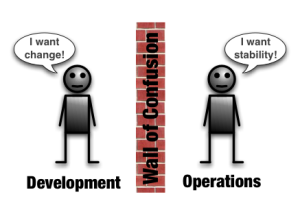
There is a lot of talk in the devops community about the importance of sharing principles and values, and about silo busting: breaking down the “wall of confusion” between developers and operations to create agile, cross-functional teams. Radical improvement through fundamental organizational changes and building an entirely new culture.

But it doesn’t have to be that hard. All it took us was 3 simple, but important, steps.

Reliability First

When we first launched our online platform, things were pretty crazy. Sales was busy with customer feedback and onboarding more customers. Development was still finishing the backlog of features that were supposed to already be done, responding to changes from sales and partners, and helping to support the system. Ops was trying to stabilize everything, help onboard more customers and address performance issues as more customers came on. We were all rushing forwards, but not always in the same direction.

Our CEO recognized this and made an important decision. He made reliability the #1 priority – the reliability and integrity of our systems and of our customers’ data, and the services we provided. For everyone: not just ops, but development, sales, marketing, compliance, admin. Above everything else. It was more important not to mess up the customers that we had than to get new customers or hit deadlines or cut costs.

Reliability, resilience, integrity have remained our #1 driver for the company over several years as we continued to grow.

This meant that everyone was working towards the same goals – and the goals were easy to understand and measure: improving MTTF, MTTD and MTTR windows; reducing bug counts and variability in response time, improving results of audits and pen tests.

It gave people more reasons to work together at more levels..

It reduced politics and conflicts to a minimum.

Development’s first priority changed from pushing features out ASAP to making sure that the system was running optimally and that any changes wouldn't negatively impact customers. This meant more time spent with ops on understanding the run-time, more time troubleshooting operational issues, more reviews and regression testing and stress testing, anticipating compatibility issues, planning for roll-back and roll-forward recovery.

Smaller, more frequent releases

Spending some more time on testing and reviews and working with ops meant that it took longer to complete a feature. But we still had to keep up with customer demands – we still had to deliver.

We did this by shortening the software release cycle, from 2-3 months to 2-3 weeks or sometimes shorter. Delivering less in each release, sometimes only 1 new feature or some fixes, but delivering much more often. If a change or feature had to be delayed, if developers or testers needed more time to make sure that it was ready, it wasn't a big deal – if something wasn't ready this week, it would be ready next week or soon after, still fast enough for the business and for customers.

Planning and working in shorter horizons meant that development could respond faster to changes in direction and changing priorities, so developers were always focused on delivering what was most important at the time.

Shorter releases drove development to be more agile, to think and work faster. To automate more testing. To pay more attention to deployment, make the steps simpler and more efficient – and safer.

Fewer changes batched together made it easier to review and test. Less chances to make mistakes. Easier to understand what went wrong when we did make a mistake, and less time to fix it.

RCA – Learn from Mistakes

We still made mistakes, shit still happened. When something went seriously wrong, it was my job to explain it to our customers and owners. What went wrong, why, and what we were going to do to make sure that it didn’t happen again.

We didn't know about blameless post mortems, but this is the way we did it anyway. We got developers and testers and ops and managers together in Root Cause Analysis sessions to carefully examine what happened, what went wrong, understand why, and fix it.

We made sure that people focused on the facts and on problem solving: what happened, what happened next, what did we see, what didn’t we see, why? What could we do to fix it or to prevent it from happening again or to recognize and respond to problems like this more effectively in the future? Better training, better tools, better procedures, better documentation, better error handling, better testing and reviews, better configuration checks and run-time checking, better information and better ways of communicating it.

Focusing on details and problems, not people. Proving that it was ok to make mistakes, but not ok to hide them. We got much better: at operations, testing, design, deployment, monitoring, incident handling. And better as an organization. We built transparency and trust within and across teams. We learned how to move forward from failure, and to be more resilient and confident in our ability to deal with serious problems.

Delivering Better and Faster Together

We didn't restructure or change who we were as an organization. Dev and ops still work in separate organizations for different managers in different countries. They have their own projects and their own ways of working, and they don’t always speak the same language or agree on everything.

We have lots of checks and balances and handoffs and paperwork between dev and ops to make sure that things are done properly and to make the regulators happy. There are still more steps that we could automate or simplify, more we can do to build out our Continuous Delivery pipelines, more things we can get out of Puppet and Vagrant and other cool tools.

But if devops is about developers and operations sharing responsibility for the system, trusting each other and helping each other to make sure that the system is always working correctly and optimally, looking for better solutions together, delivering better and faster – then we’ve been doing devops for a while now.

Thursday, March 27, 2014

Secure DevOps - Seems Simple

The DevOps security story is deceptively simple. It’s based on a few fundamental, straight forward ideas and practices:

Smaller Releases are Safer

One of these ideas is that smaller, incremental and more frequent releases are safer and cause less problems than big bang changes. Makes sense.

Smaller releases contain less code changes. Less code means less complexity and fewer bugs. And less risk, because smaller releases are easier to understand, easier to plan for, easier to test, easier to review, and easier to roll back if something goes wrong.

And easier to catch security risks by watching out for changes to high risk areas of code: code that handles sensitive data, or security features or other important plumbing, new APIs, error handling. At Etsy for example, they identify this code in reviews or pen testing or whatever, hash it, and automatically alert the security team when it gets changed, so that they can make sure that the changes are safe.

Changing the code more frequently may also make it harder for the bad guys to understand what you are doing and find vulnerabilities in your system – taking advantage of a temporary “Honeymoon Effect” between the time you change the system and the time that the bad guys figure out how to exploit weaknesses in it.

And changing more often forces you to simplify and automate application deployment, to make it repeatable, reliable, simpler, faster, easier to audit. This is good for change control: you can put more trust in your ability to deploy safely and consistently, you can trace what changes were made, who made them, and when.

And you can deploy application patches quickly if you find a problem.

“...being able to deploy quick is our #1 security feature”
Effective Approaches to Web Application Security, Zane Lackey

Standardized Ops Environment through Infrastructure as Code

DevOps treats “Infrastructure as Code”: infrastructure configurations are defined in code that is written and managed in the same way as application code, and deployed using automated tools like Puppet or Chef instead of by hand. Which means that you always know how your infrastructure is setup and that it is setup consistently (no more Configuration Drift). You can prove what changes were made, who made them, and when.

You can deploy infrastructure changes and patches quickly if you find a problem.

You can test your configuration changes in advance, using the same kinds of automated unit test and integration test suites that Agile developers rely on – including tests for security.

And you can easily setup test environments that match (or come closer to matching) production, which means you can do a more thorough and accurate job of all of your testing.

Automated Continuous Security Testing

DevOps builds on Agile development practices like automated unit/integration testing in Continuous Integration, to include higher level automated system testing in Continuous Delivery/Continuous Deployment.

You can do automated security testing using something like Gauntlt to “be mean to your code” by running canned attacks on the system in a controlled way.

Other ways of injecting security into Devops include:

  1. Providing developers with immediate feedback on security issues through self-service static analysis: running Static Analysis scans on every check-in, or directly in their IDEs as they are writing code.
  2. Helping developers to write automated security unit tests and integration tests and adding them to the Continuous testing pipelines.
  3. Automating checks on Open Source and other third party software dependencies as part of the build or Continuous Integration, using something like OWASP’s Dependency Check to highlight dependencies that have known vulnerabilities.
Fast feedback loops using automated testing means you can catch more security problems – and fix them – earlier.

Operations Checks and Feedback

DevOps extends the idea of feedback loops to developers from testing all the way into production, allowing (and encouraging) developers visibility into production metrics and getting developers and ops and security to all monitor the system for anomalies in order to catch performance problems and reliability problems and security problems.

Adding automated asserts and health checks to deployment (and before start/restart) in production to make sure key operational dependencies are met, including security checks: that the configurations correct, ports that should be closed are closed, ports that should be opened are opened, permissions are correct, SSL is setup properly…

Or even killing system processes that don’t conform (or sometimes just to make sure that they failover properly, like they do at Netflix).

People talking to each other and working together to solve problems

And finally DevOps is about people talking together and solving problems together. Not just developers talking to the business/customers. Developers talking to ops, ops talking to developers, and everybody talking to security. Sharing ideas, sharing tools and practices. Bringing ops and security into the loop early. Dev and ops and security working together on planning and on incident response and learning together in Root Cause Analysis sessions and other reviews. Building teams across silos. Building trust.

Making SecDevOps Work

There’s good reasons to be excited by what these people are doing, the path that they are going down. It promises a new, more effective way for developers and security and ops to work together.

But there are some caveats.

Secure DevOps requires strong engineering disciplines and skills. DevOps engineering skills are still in short supply. And so are information security(and especially appsec) skills. People who are good at both DevOps and appsec are a small subset of these small subsets of the talent available.

Outside of configuration management and monitoring, the tooling is limited – you’ll probably have to write a lot of what you need yourself (which leads quickly back to the skills problem).

A lot more work needs to be done to make this apply to regulated environments, with enforced separation of duties and where regulators think of Agile as “the A Word” (so you can imagine what they think of developers pushing out changes to production in Continuous Deployment, even if they are using automated tools to do it). A small number of people are exploring these problems in a Google discussion group on DevOps for managers and auditors in regulated industries, but so far there are more people asking questions than offering answers.

And getting dev and ops and security working together and collaborating across development, ops and security might take an extreme makeover of your organization’s structure and culture.

Secure DevOps practices and ideas aren't enough by themselves to make a system secure. You still need all of the fundamentals in place. Even if they are releasing software incrementally and running lots of automated tests, developers still need to understand software security and design security in and follow good software engineering practices. Whether they are using "Infrastructure as Code" or not, Ops still has to design and engineer the datacenter and the network and the rest of the infrastructure to be safe and reliable, and run things in a secure and responsible way. And security still needs to train everyone and followup on what they are doing, run their scans and pen tests and audits to make sure that all of this is being done right.

Secure DevOps is not as simple as it looks. It needs disciplined secure development and secure ops fundamentals, and good tools and rare skills and a high level of organizational agility and a culture of trust and collaboration. Which is why only a small number of organizations are doing this today. It’s not a short term answer for most organizations. But it does show a way for ops and security to keep up with the high speed of Agile development, and to become more agile, and hopefully more effective, themselves.

Site Meter